Clarity Toolkit - Advanced
Clarity Toolkit - Advanced (CT2) develops deeper analytical thinking by teaching structured breakdown, prioritization, and consequence awareness.
01 wk
Course Duration
4.6

1 Reviews
2
Total Learners
About
Module
Testimonial
FAQ
What's This Course About?
While Clarity Tool - Basic (CT1) builds everyday decision clarity, CT2 strengthens analytical depth.
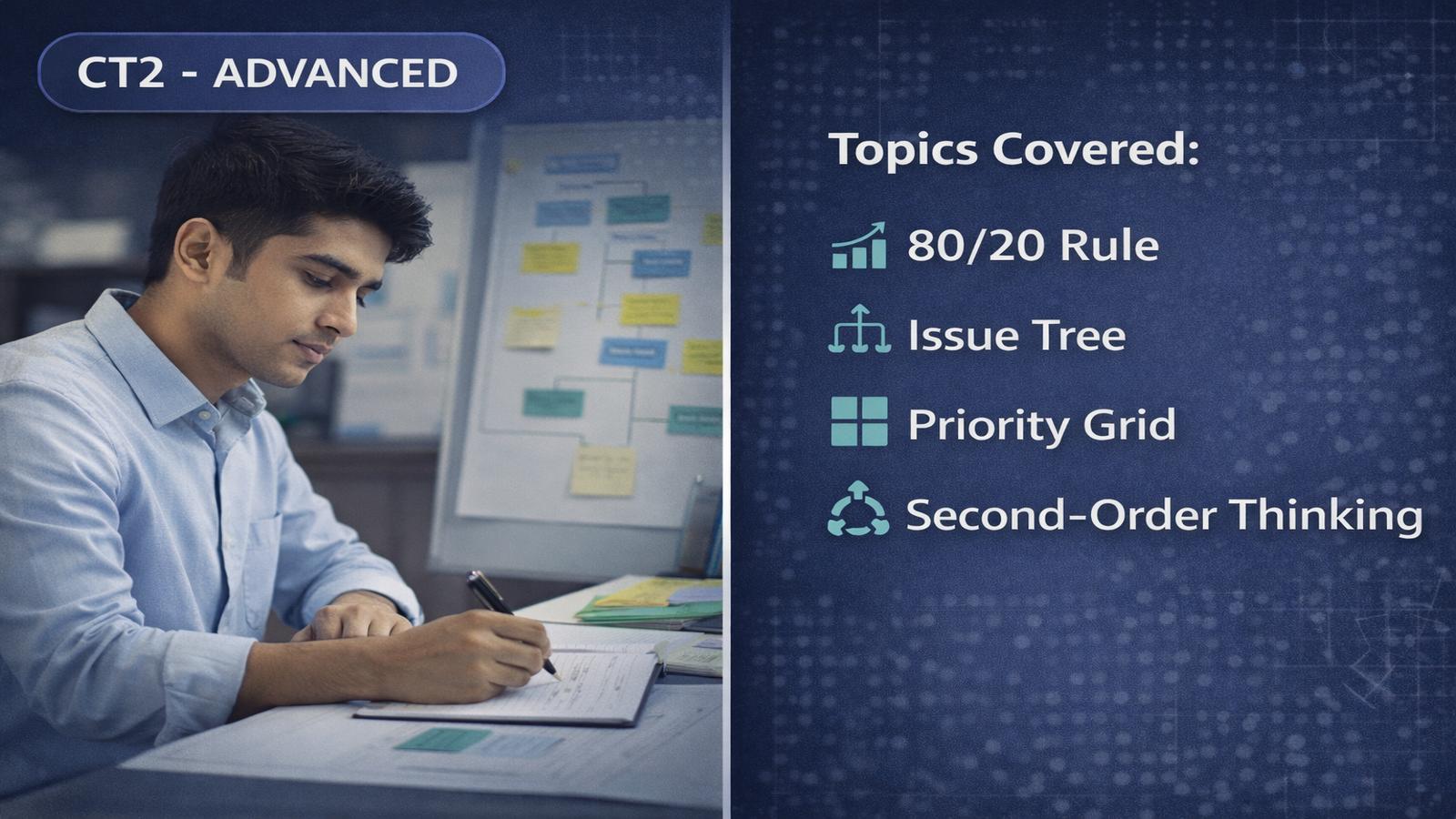
Many complex problems feel overwhelming not because they are unsolvable- but because they are unstructured. CT2 introduces four advanced thinking tools that help learners break down complexity, prioritize intelligently, anticipate consequences, and focus on what truly matters.
The Issue Tree / Logic Tree trains learners to break large problems into clear, logical components.
The Pareto Principle (80/20 Rule) sharpens prioritization by identifying the few factors that drive most outcomes.
Second-Order Thinking develops the ability to think beyond immediate consequences and anticipate ripple effects.
Priority Grid helps to bring focus where it matters the most.
These tools are widely used in consulting, strategy, management, and leadership environments-but here they are simplified for practical application.
What you'll learn
-
 Break complex problems into logical components
-
Prioritise high-impact factors over noise
-
Anticipate long-term consequences of decisions
-
Focus energy on controllable and influential areas
What you'll learn
1. Break complex problems into structured logical components 2. Prioritize high-impact drivers using analytical frameworks 3. Think beyond immediate consequences 4. Allocate effort strategically using structured grids 5. Apply professional-grade analysis to real-world decisions
Short Description
Break complexity logically, Focus on high-impact drivers, Think beyond first consequences, Analyze before deciding
What you'll learn
1. Identify the few high-impact factors driving most outcomes 2. Distinguish between critical tasks and low-value effort 3. Prioritise actions that generate disproportionate results 4. Eliminate noise and focus on meaningful leverage points
Short Description
Focus on what truly matters, Prioritise high-impact effort, Cut noise, increase results
What you'll learn
1. Distinguish high-impact tasks from low-value activities 2. Evaluate effort versus return before committing resources 3. Prioritise actions strategically instead of reactively 4. Focus on leverage tasks that accelerate progress
Short Description
Focus on high-impact work, Balance effort vs return, Prioritise with clarity
What you'll learn
1. Identify immediate consequences versus long-term ripple effects 2. Anticipate indirect outcomes of decisions 3. Evaluate trade-offs beyond surface-level benefits 4. Make decisions with future impact in mind
Short Description
Think beyond first impact, Anticipate ripple effects, Decide with foresight
What you'll learn
1. Break complex problems into logically structured components 2. Organise ideas into mutually exclusive, collectively exhaustive branches 3. Identify root drivers behind large, ambiguous problems 4. Build clear problem-solving pathways instead of jumping to conclusions
Short Description
Break complexity logically, Structure problems clearly, Think in branches, not chaos.
Instructor Spotlight

DeepClarity
Business Leader

980 students

4.7 Rating
The courses at DeepClarity are authored by a group of practitioners who combine strong academic pedigree with deep real-world experience.
They are graduates from leading institutes of India like NIT/IIT/IIMs and have spent their professional career working on complex, high-stakes decisions in real business environments.
Over the years, a clear gap became evident to them: Many young people work hard, learn skills, and chase opportunities - yet struggle to think clearly, choose wisely, and communicate decisively. DeepClarity was created to address this gap.
Driven by a strong belief that better thinking leads to better choices, the author brings together decision-making tools designed specifically to help youngsters.
₹ 333 ₹ 499
Start CourseInside the Course

Clear, step-by-step video lessons, Ready-to-use frameworks & templates, Guided practice exercises, Concept-check quizzes, Working notes & quick-reference sheets
Clarity That Changes Lives
Real voices. Real clarity. Real transformation.

Nisha Rao
4.6


Frequently Asked Questions
Still you have any questions? Contact our Team via support feedback@deepclarity.in