Clarity Toolkit - Basic
01 wk
Course Duration
5.0

2 Reviews
2
Total Learners
About
Module
Testimonial
FAQ
What's This Course About?
Many poor decisions happen not because people lack intelligence, but because their thinking lacks structure. When faced with choices, learners often rely on instinct, emotion, or endless overthinking.
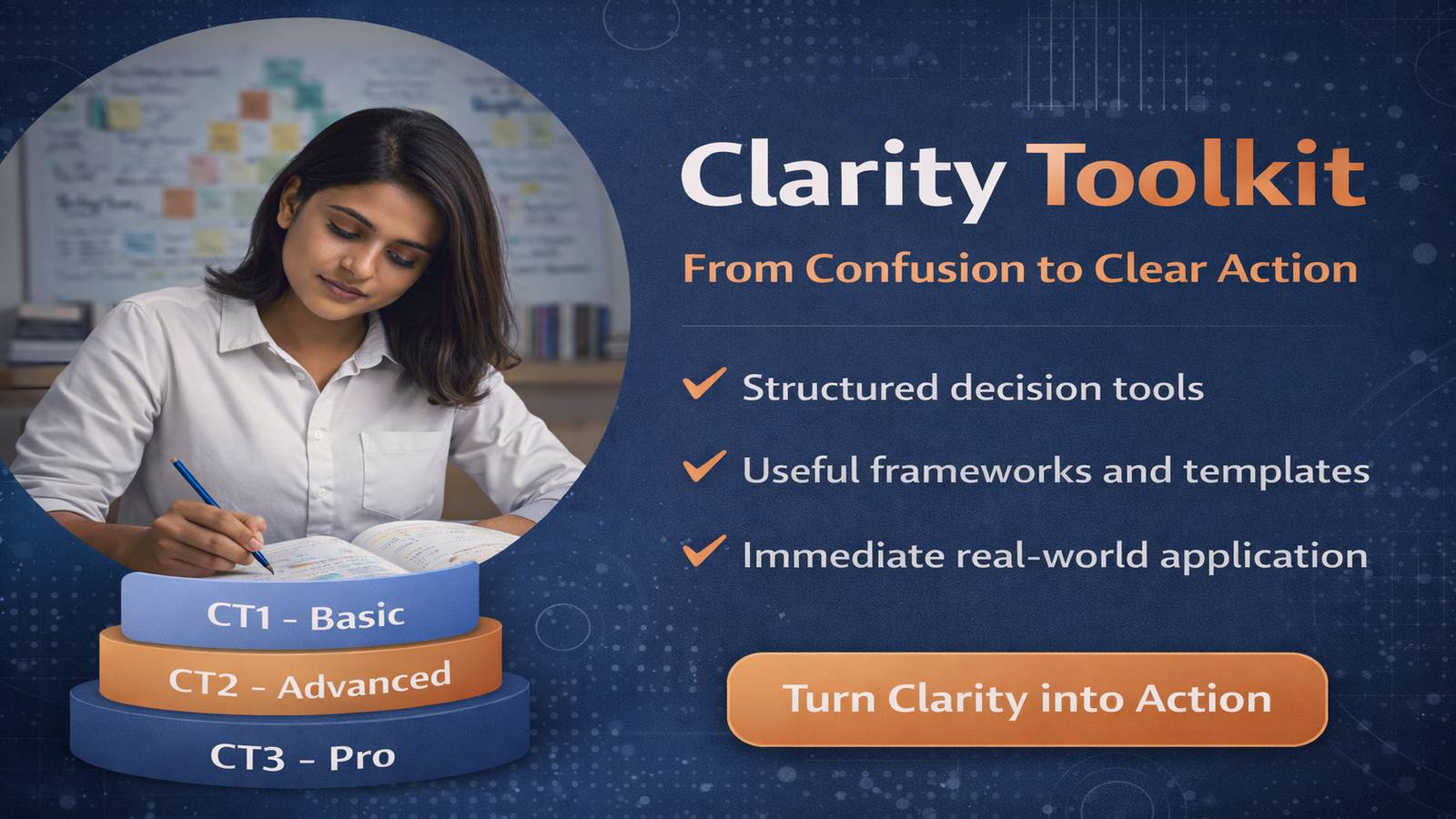
CT - Basic introduces four powerful yet easy-to-use decision tools designed for everyday clarity.
- The 5 Whys helps uncover the real root of a problem instead of addressing surface symptoms.
- Pros-Cons-Implications (PCI) trains learners to evaluate options thoughtfully and anticipate consequences.
- SWOT provides a structured way to assess strengths, weaknesses, opportunities, and risks.
- The Decision Matrix (2×2 Grid) helps compare options objectively and make trade-offs visible.
These tools are practical, simple, and immediately applicable to academic choices, projects, and personal decisions.
What you'll learn
-
 Identify the real root of a problem using structured questioning
-
Evaluate options logically using simple decision frameworks
-
Compare choices objectively instead of relying on impulse
What you'll learn
1. Understand why structured tools outperform random thinking 2. Recognize when to apply simple decision frameworks 3. Appreciate the power of clarity before action 4.See how small tools can create disproportionate impact 5. Commit to disciplined thinking in everyday choices
Short Description
Use simple tools wisely, Structure everyday decisions, Turn confusion into clarity, Think before acting
What you'll learn
1. Identify the root cause of a problem instead of reacting to symptoms 2.Use structured questioning to uncover hidden causes 3. Avoid premature conclusions in decision-making
Short Description
Go beyond surface problems, Ask better questions, Solve at the root
What you'll learn
1. Evaluate options beyond simple advantages and disadvantages 2. Identify short-term and long-term implications of decisions 3. Compare choices logically instead of emotionally 4. Make balanced decisions with visible trade-offs
Short Description
Go beyond pros & cons, Think ahead before choosing, Evaluate trade-offs clearly
What you'll learn
1. Assess strengths and weaknesses objectively 2. Identify external opportunities and risks clearly 3. Separate internal factors from external factors 4. Use SWOT to evaluate academic, personal, or project decisions
Short Description
Know your strengths clearly, Spot risks early, Evaluate situations with balance
What you'll learn
1. Compare options using clear evaluation criteria 2. Visualise trade-offs using a simple 2×2 grid 3. Prioritise choices objectively instead of emotionally 4. Make structured decisions when options compete
Short Description
Compare options clearly, Make trade-offs visible, Decide with structure
Instructor Spotlight

DeepClarity
Business Leader

980 students

4.7 Rating
The courses at DeepClarity are authored by a group of practitioners who combine strong academic pedigree with deep real-world experience.
They are graduates from leading institutes of India like NIT/IIT/IIMs and have spent their professional career working on complex, high-stakes decisions in real business environments.
Over the years, a clear gap became evident to them: Many young people work hard, learn skills, and chase opportunities - yet struggle to think clearly, choose wisely, and communicate decisively. DeepClarity was created to address this gap.
Driven by a strong belief that better thinking leads to better choices, the author brings together decision-making tools designed specifically to help youngsters.
₹ 333 ₹ 499
Start CourseInside the Course

Clear, step-by-step video lessons, Ready-to-use frameworks & templates, Guided practice exercises, Concept-check quizzes, Working notes & quick-reference sheets
Clarity That Changes Lives
Real voices. Real clarity. Real transformation.

Tanmay Kulkarni
4.9


S Datta
5.0
Frequently Asked Questions
Still you have any questions? Contact our Team via support feedback@deepclarity.in