Clarity Toolkit - Pro
Clarity Toolkit Pro (CT3) develops advanced strategic thinking skills to navigate uncertainty, assess risk intelligently, and plan for multiple future outcomes.
01 wk
Course Duration
0.0

0 Reviews
2
Total Learners
About
Module
FAQ
What's This Course About?
While CT1 builds structured decisions and CT2 sharpens analytical depth, CT3 prepares learners for high-stakes, uncertain environments.
In real life, important decisions rarely come with full information. Outcomes are probabilistic, trade-offs are real, and future consequences are uncertain. CT3 equips learners with strategic tools used by leaders, entrepreneurs, and decision-makers to think ahead rather than react.
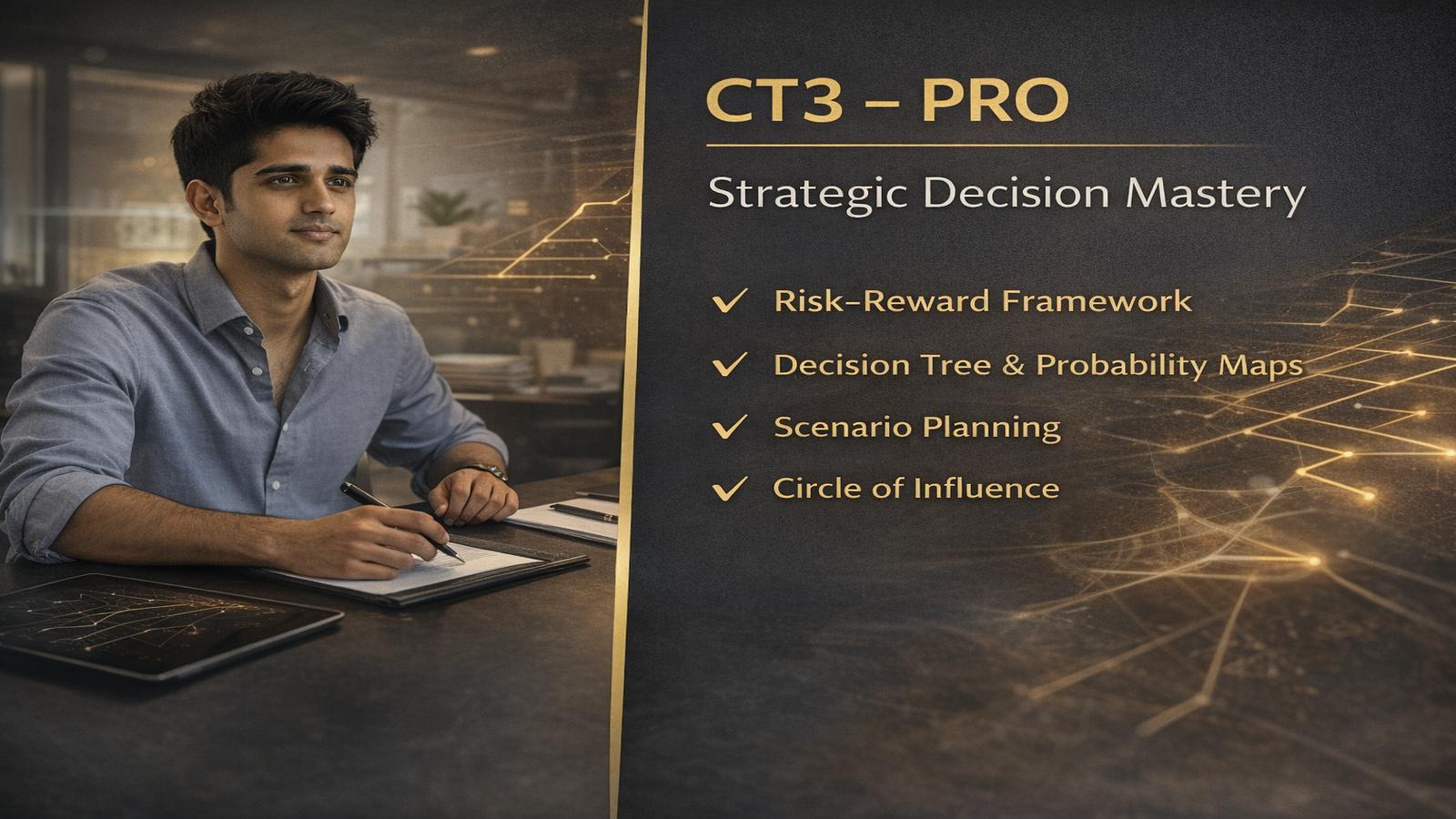
The Risk-Reward Framework trains learners to evaluate trade-offs consciously.
Decision Trees & Probability Maps introduce structured thinking under uncertainty.
Scenario Planning builds long-term foresight by preparing for multiple possible futures.
The Circle of Influence reinforces strategic focus on areas where leverage is possible.
CT3 moves learners from analysis to anticipation. Instead of asking, "What should I do now?" they begin asking, "What happens next and what if?".
By the end of CT3, learners think like strategists, not just problem-solvers.
What you'll learn
-
 Evaluate risk versus return before committing
-
Make decisions under uncertainty using structured probability thinking
-
Anticipate multiple future scenarios
-
Focus influence strategically rather than react emotionally
What you'll learn
Understand the basic skills required for taking decisions under uncertainty
Short Description
Get a sneak peak about the modules that will be covered.
What you'll learn
1. Evaluate potential rewards against associated risks systematically 2. Distinguish between calculated risk and reckless decision-making 3. Identify asymmetric opportunities (low risk, high reward) 4. Make high-stakes decisions with conscious trade-off awareness
Short Description
Weigh risk intelligently, Spot asymmetric opportunities, Decide with calculated confidence
What you'll learn
1. Map decisions into structured branches with possible outcomes 2. Assign probabilities to uncertain events logically 3. Evaluate expected value before choosing 4. Compare multiple decision paths objectively
Short Description
Think in probabilities, Map outcomes clearly, Choose with calculated logic
What you'll learn
1. Develop multiple plausible future scenarios 2. Identify uncertainties that can change outcomes 3. Plan strategic responses for different future paths 4. Work backward from a desired future to define present actions
Short Description
Think in future scenarios, Prepare for uncertainty, Design the future backward
What you'll learn
1. Distinguish between control, influence, and concern 2. Allocate attention strategically 3. Avoid emotional energy leaks 4. Expand influence systematically over time
Short Description
Focus where leverage exists, Stop wasting cognitive energy, Expand influence deliberately
Instructor Spotlight

DeepClarity
Business Leader

980 students

4.7 Rating
The courses at DeepClarity are authored by a group of practitioners who combine strong academic pedigree with deep real-world experience.
They are graduates from leading institutes of India like NIT/IIT/IIMs and have spent their professional career working on complex, high-stakes decisions in real business environments.
Over the years, a clear gap became evident to them: Many young people work hard, learn skills, and chase opportunities - yet struggle to think clearly, choose wisely, and communicate decisively. DeepClarity was created to address this gap.
Driven by a strong belief that better thinking leads to better choices, the author brings together decision-making tools designed specifically to help youngsters.
₹ 333 ₹ 499
Start CourseInside the Course

Clear, step-by-step video lessons, Ready-to-use frameworks & templates, Guided practice exercises, Concept-check quizzes, Working notes & quick-reference sheets
Frequently Asked Questions
Still you have any questions? Contact our Team via support feedback@deepclarity.in