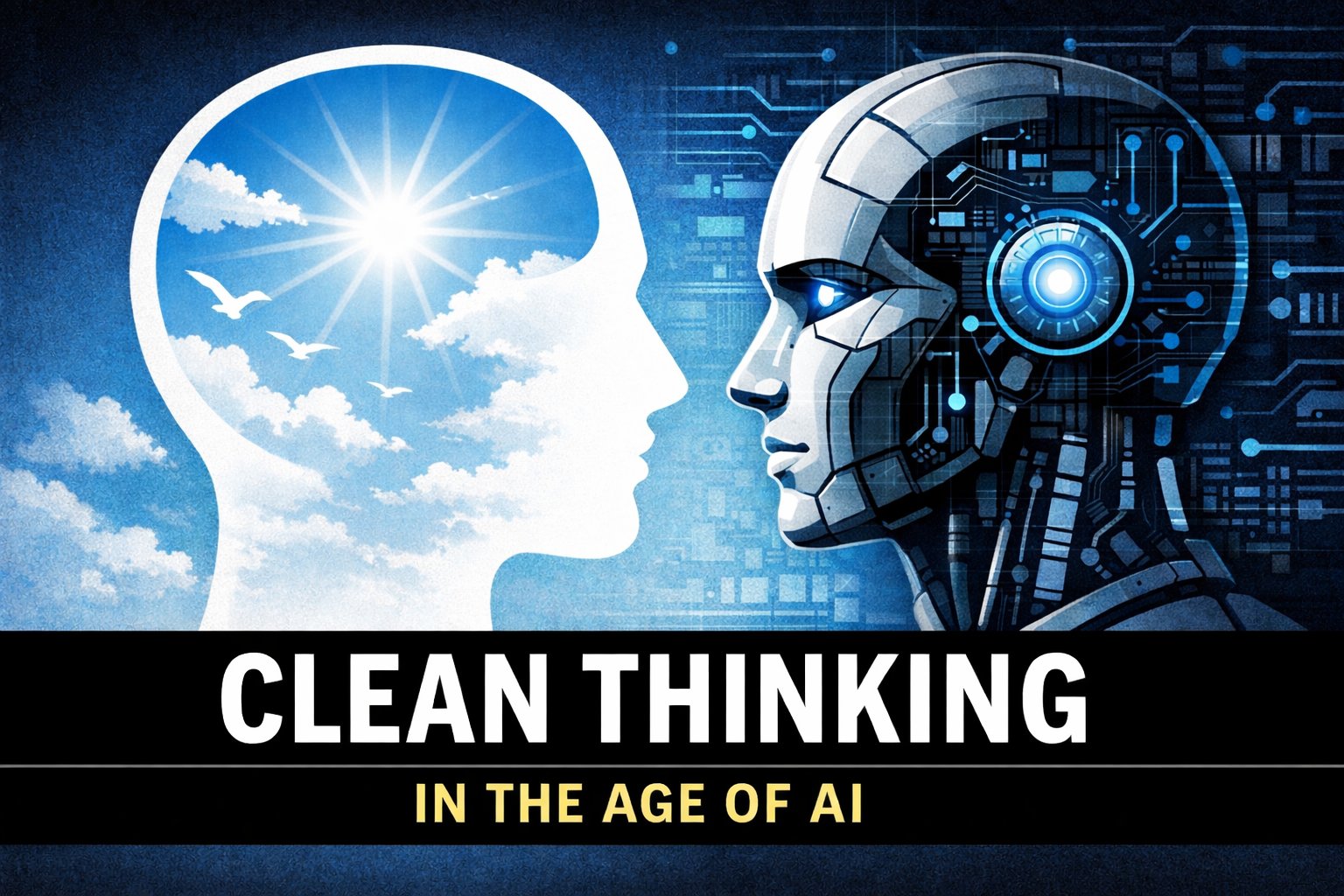

Artificial Intelligence can draft reports, analyze data, generate strategies, and even simulate creativity in seconds. Tasks that once required teams now require prompts.
Yet here's the paradox: As machines become smarter, human thinking must become cleaner.
AI is powerful -- but it does not think. It predicts. It synthesizes patterns from past data. It produces convincing outputs. But it does not define purpose, choose values, or take responsibility. That still belongs to us.
The Illusion of Intelligence
AI often sounds authoritative. It delivers structured answers at incredible speed. But speed is not judgment, and fluency is not truth.The risk today is not lack of information -- it is false confidence. AI-generated content can appear coherent while hiding flawed assumptions, missing context, or subtle bias.
Without clean thinking, we risk accepting polished nonsense. Clean thinking means:
- Separating facts from assumptions
- Identifying bias -- both in the system and in ourselves
- Structuring problems logically
- Distinguishing signal from noise
- Asking better questions before seeking better answers
In a world flooded with outputs, discernment becomes power.
AI Amplifies Your Mind
AI is an amplifier. If your thinking is unclear, AI amplifies confusion. If your thinking is structured, AI accelerates excellence.
The advantage has shifted. In the past, access to information created leverage. Today, information is abundant. Tomorrow, advantage belongs to those who can:
Frame the right problems
- Design precise prompts
- Critically evaluate outputs
- Integrate insights into coherent decisions
AI cannot decide what matters most. It cannot weigh ethical trade-offs. It cannot align choices with long-term vision. Clean thinking fills that gap.
The Acceleration Trap
AI compresses time. Decisions that once took weeks now take minutes. But faster access to analysis does not guarantee better decisions. Speed increases risk:
- Acting before reflection
- Over-relying on automation
- Mistaking output for understanding
Clean thinking introduces disciplined pause:
- What assumptions is this based on?
- What data might be missing?
- What are the second-order consequences?
- What would disprove this conclusion?
When everything accelerates, intentional reflection becomes strategic.
Bias: Human + Machine
AI systems inherit bias from data. Humans carry cognitive biases -- confirmation bias, anchoring, overconfidence.
Together, they create a dangerous loop: AI suggests → Human agrees → Bias strengthens.
Clean thinking breaks that loop. It demands skepticism - not negativity, but intellectual hygiene.
Creativity and Responsibility
AI can generate options. It can remix ideas. It can simulate originality. But vision, ethics, and accountability remain human responsibilities.
In business, education, governance, and personal decisions, the critical step is not generating possibilities - it is choosing wisely.
AI can optimize processes. Clean thinking determines direction.
The Real Risk
The true danger of AI is not superintelligence. It is intellectual complacency. If humans outsource too much cognition, critical reasoning weakens. Attention fragments. Judgment erodes.
Cognitive muscles, like physical ones, decline without use. Clean thinking is deliberate mental discipline. It requires questioning assumptions, clarifying goals, mapping decisions, and seeking disconfirming evidence.
The Edge of the Future
AI will continue to evolve. Tools will become more autonomous, more powerful, more integrated into daily life. But the future will not belong to those who simply use AI. It will belong to those who use it intelligently.
In the age of artificial intelligence, the ultimate competitive advantage is not artificial at all. It is clarity.
---------------------------------------------------------------------
You've read the ideas. Now test your clarity.
Take the DeepClarity Assessment and discover how structured your thinking really is.