
In periods of heightened uncertainty, decision-making tends to accelerate.
Leaders act. Positions harden. Signals are sent.
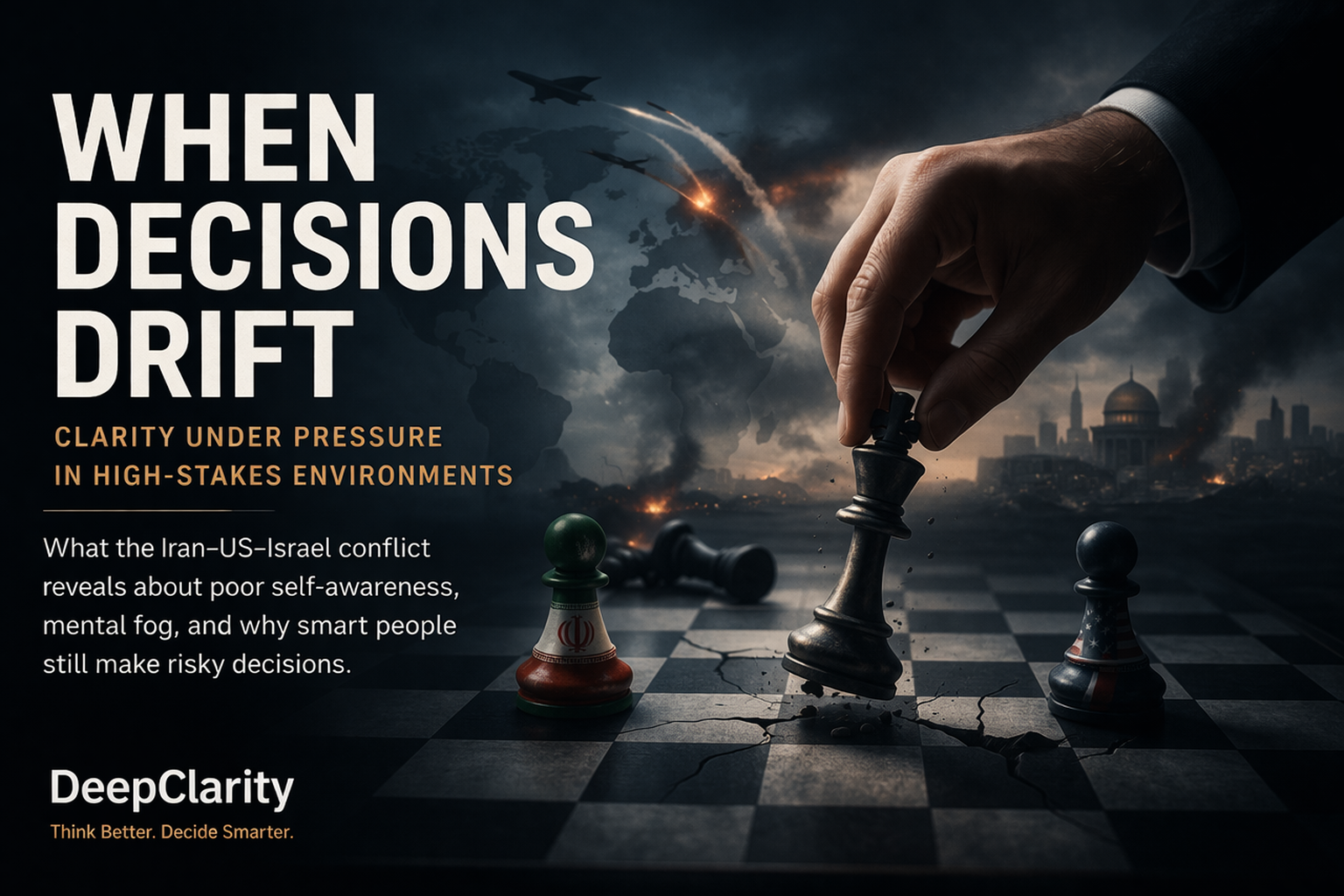
From the outside, this often appears as decisive leadership. Yet, a closer examination of high-stakes situations--including ongoing geopolitical conflicts--reveals a recurring pattern: the velocity of action increases even as clarity declines.
This divergence creates a critical risk.Not because decision-makers lack intelligence or information, but because decisions begin to drift from clearly defined objectives toward reactive momentum.
The Drift from Strategy to Reaction
Effective decision-making requires alignment between three elements:
a clearly defined objective, a set of evaluated alternatives, and an understanding of trade-offs.
Under pressure, this alignment weakens. Time constraints compress analysis. External pressures--political, social, or emotional--begin to influence judgment. Pre-existing narratives take precedence over fresh evaluation.
As a result, action continues, but its strategic anchor erodes. Escalation is interpreted as progress. Responsiveness is mistaken for control.In reality, the system is moving without a clearly articulated end-state.
Decision Fog in Complex Systems
This phenomenon can be described as decision fog--a condition in which:
- Activity levels rise
- Stakes intensify
- But decision quality deteriorates
Decision fog does not manifest as inaction. On the contrary, it is often characterised by continuous movement. The risk lies in the absence of structured thinking beneath that movement.
In such environments, organizations and nations become susceptible to path dependency. Initial decisions, made under incomplete clarity, create a trajectory that becomes increasingly difficult to alter.
Over time, momentum substitutes for judgment.
The Role of Self-Awareness
At the core of decision fog is a less visible but more fundamental issue: insufficient self-awareness at the point of decision. Decision-makers rarely interrogate the internal drivers of their choices with sufficient rigour. Key questions are often overlooked:
- To what extent is this decision influenced by external pressure versus strategic intent?
- Are we responding to current conditions, or reinforcing past positions?
- What cognitive or emotional biases are shaping our interpretation of events?
Without this layer of introspection, three distortions typically emerge:
1. Narrative Dominance: Existing beliefs or ideological positions begin to dictate decisions, even when circumstances have evolved.
2. Escalation Commitment: The cost of reversing direction is perceived as too high, leading to continued investment in a suboptimal path.
3. Emotional Rationalization: Urgency, fear, or reputational concerns are reframed as strategic imperatives.
These distortions are not unique to geopolitical leadership. They are observable across corporate and individual decision-making contexts.
A Transferable Pattern
The same structural weaknesses appear in everyday decisions:
- Career choices driven by immediate pressure rather than long-term alignment
- Financial decisions influenced by fear of missing out rather than risk assessment
- Organizational strategies shaped by short-term signals rather than underlying fundamentals
In each case, the individual or organisation is not making a fully evaluated decision.They are resolving immediate tension.This distinction is subtle but consequential.
Restoring Decision Clarity
If decision drift is the problem, the solution lies in reintroducing structure. High-quality decisions--particularly under pressure--require deliberate frameworks that counteract emotional and contextual noise.
A practical approach includes five elements:
1. Objective Definition
Explicitly articulate the desired end-state. Ambiguity at this stage propagates throughout the decision process.
2. Alternative Generation
Develop multiple viable options, including the option to delay or not act. A single-path approach limits analytical rigor.
3. Downside Evaluation
Assess the irreversible costs associated with each option. Effective decision-making prioritizes risk containment alongside opportunity.
4. Bias Identification
Surface the potential influence of cognitive biases, institutional narratives, and external pressures.
5. Exit Criteria
Define conditions under which the chosen course of action will be reassessed or reversed.
This structure does not eliminate uncertainty. It disciplines it.
The Strategic Value of Clarity
In complex, high-pressure environments, competitive advantage does not accrue to the fastest or most forceful actor.It accrues to the actor that maintains clarity of purpose under conditions of ambiguity.
Such clarity enables:
- Coherent alignment between actions and objectives
- Flexibility in response to changing conditions
- Resistance to unnecessary escalation
Most importantly, it preserves the ability to choose--not merely to continue.
Conclusion
Periods of crisis test not only the resilience of systems, but the quality of decisions within them. The central risk is not inaction, but unstructured action--activity that is decoupled from clear intent. Whether in geopolitics, organisations, or individual life choices, the principle remains consistent: The quality of outcomes is a function of the clarity underlying decisions.
And clarity, particularly under pressure, is not instinctive. It is the result of disciplined thinking.